The Customs Clearance Process in India is an essential step for businesses importing products into the country. While importing products into India can create significant business opportunities, bringing goods into the country involves much more than arranging international shipping. Every commercial shipment must comply with Indian Customs requirements, import policies, product regulations, documentation standards, and applicable duties before the goods can enter the domestic market.
Understanding the customs clearance process in India is therefore essential for foreign manufacturers, Indian importers, distributors, trading companies and businesses planning to enter the Indian market.
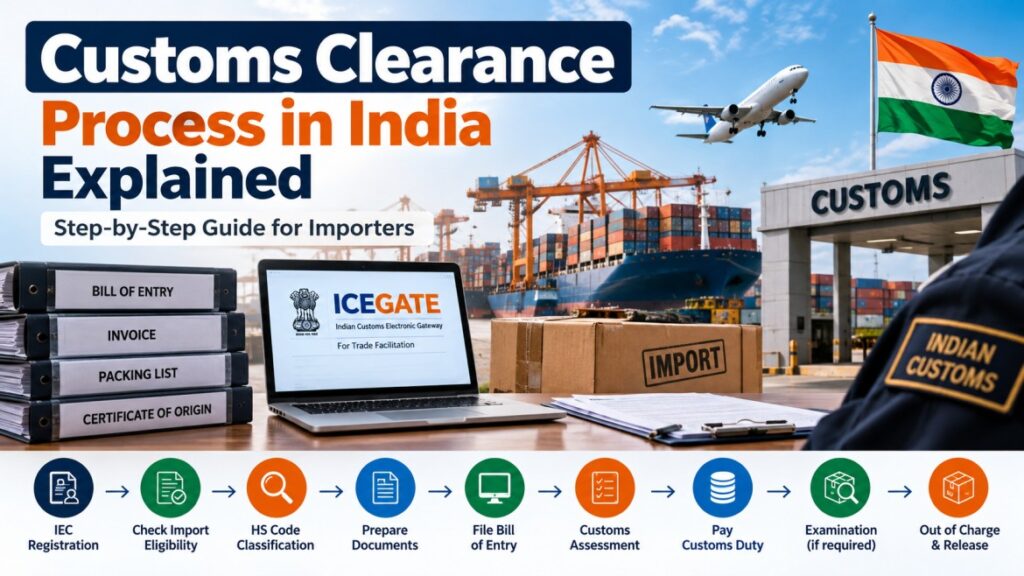
The process generally includes checking import eligibility, obtaining an Importer Exporter Code (IEC), classifying the goods under the correct tariff heading, preparing shipping documents, filing the Bill of Entry, completing Customs assessment, obtaining product-specific approvals where applicable, paying import duties and finally receiving the Customs Out of Charge (OOC) permission.
India’s Customs Act requires imported goods intended for home consumption or warehousing to be entered through a Bill of Entry, generally filed electronically through the Customs automated system.
This guide explains the customs clearance process in India step by step, including the required documents, Customs duty, ICEGATE procedures, regulatory approvals and common mistakes importers should avoid.
What Is Customs Clearance in India?
Customs clearance is the legal and administrative process through which imported goods are declared, assessed, verified and permitted to enter India.
During the Indian customs clearance process, Customs authorities may verify:
- Description and nature of the goods
- HS/Customs Tariff classification
- Quantity
- Country of origin
- Import value
- Applicable Customs duty
- Import policy status
- Product certifications
- Regulatory licences
- Supporting import documents
- Eligibility for exemptions or preferential duty
Customs duty on imported goods is governed primarily by the Customs Act, 1962 and Customs Tariff Act, 1975, along with relevant notifications, rules and other applicable legislation.
The objective of the customs clearance process in India is not only tax collection. Customs authorities also ensure that prohibited, restricted or non-compliant goods do not enter the country without meeting applicable legal requirements.
Quick Overview of the Customs Clearance Process in India
For most commercial imports, the process follows this sequence:
Importer readiness → Product compliance check → Shipment documentation → Cargo arrival/manifest → Bill of Entry filing → Self-assessment → Customs/PGA verification → Duty payment → Examination, if selected → Out of Charge → Delivery
India uses ICEGATE — the Indian Customs Electronic Gateway — as a central digital platform for electronic interaction between Customs and the trading community. ICEGATE supports services including Bill of Entry filing, duty payment, document submission, enquiries and other Customs-related processes.
Step 1: Obtain an Importer Exporter Code (IEC)
One of the first requirements for commercial imports is an Importer Exporter Code, commonly known as IEC.
Under India’s Foreign Trade Policy framework, an IEC is generally mandatory for undertaking import or export activities unless a specific exemption applies. The IEC is issued through the Directorate General of Foreign Trade (DGFT) and is linked to the entity’s PAN.
For businesses planning regular import customs clearance in India, the IEC should be prepared before the shipment is dispatched.
Importers should also ensure that company information, PAN, GST details, bank information and other registration details are consistent across Customs and trade documentation.
Step 2: Check Whether the Product Can Be Imported into India
Before shipping goods, businesses should confirm whether the product is:
Freely importable, restricted, prohibited or subject to specific conditions.
This is one of the most important stages of the customs clearance process in India because Customs clearance can become delayed even when the transportation documents are correct if the product itself requires an approval that has not been obtained.
Depending on the product category, additional approval may be required from authorities such as:
BIS for certain notified electrical, electronic, industrial and consumer products.
FSSAI for food products, ingredients and applicable food-related imports.
CDSCO for applicable cosmetics, medical devices, drugs and healthcare products.
Other products may be subject to environmental, plant quarantine, animal quarantine, wireless, chemical, legal metrology or other regulatory requirements.
DGFT also confirms that additional documents may be required where goods are subject to policy conditions, restrictions or product-specific statutory requirements.
Businesses importing regulated goods should therefore complete a product compliance assessment before shipping, rather than discovering the requirement after the cargo reaches India.
For further guidance, businesses can review SAVI Enterprises’ guide on FSSAI, BIS, CDSCO and Product Certification in India.
Step 3: Identify the Correct HS Code
Every imported product must be classified under the appropriate Customs Tariff Heading or HS Code.
The HS code influences several important elements of the customs clearance process in India, including the applicable Basic Customs Duty, IGST, policy conditions, exemptions, anti-dumping measures and product-specific compliance requirements.
Incorrect classification can lead to:
Higher duty liability, reassessment, Customs queries, shipment delays, demand for additional documents or disputes regarding classification.
Importers should therefore verify classification based on the actual product description, material, function, technical specification and intended use rather than selecting an HS code only because it provides a lower duty rate.
ICEGATE’s Compliance Information Portal provides commodity-wise Customs procedures, regulatory requirements, agency information and duty information based on Customs tariff classifications.
Step 4: Prepare Customs Clearance Documents
Correct documentation is one of the foundations of smooth customs clearance in India.
DGFT identifies the main mandatory import documents as the transport document, Commercial Invoice-cum-Packing List and Bill of Entry. Separate commercial invoices and packing lists are also accepted. Additional documents may be required depending on the product or applicable regulations.
A practical documentation set may include:
| Document | Purpose |
|---|---|
| Commercial Invoice | Shows buyer, seller, value, currency and product details |
| Packing List | Provides quantity, package, weight and packing details |
| Bill of Lading / Air Waybill | Transportation and shipment evidence |
| Bill of Entry | Main Customs declaration for imported goods |
| IEC Details | Importer identification |
| Certificate of Origin | Confirms origin and may support preferential tariff claims |
| Insurance / Freight Documents | May support Customs valuation |
| Purchase Order / Contract | Supports transaction details |
| BIS / FSSAI / CDSCO or other approvals | Required for regulated products where applicable |
| Technical Catalogue | Helps establish product specifications and classification |
Documents supporting the Bill of Entry can also be handled electronically through the Customs ecosystem, including e-SANCHIT functionality. ICEGATE notes that commodity-specific and Participating Government Agency requirements may require additional documentation.
Step 5: File the Bill of Entry
The Bill of Entry is one of the most important documents in the customs clearance process in India.
It contains information relating to the importer, shipment, goods description, tariff classification, value, country of origin, applicable exemptions, duties and other declarations.
Under Section 46 of the Customs Act, the Bill of Entry is generally presented electronically on the Customs automated system.
Current law generally requires the Bill of Entry to be presented before the end of the day preceding the day on which the carrying vessel, aircraft or vehicle arrives at the Customs station, subject to prescribed exceptions. A Bill of Entry may also generally be filed up to 30 days before the expected arrival of the goods.
Early filing can help businesses prepare the import clearance process in India before the cargo physically arrives.
Step 6: Customs Self-Assessment
India follows a system of self-assessment for imported goods.
Under Section 17 of the Customs Act, the importer self-assesses the Customs duty applicable to the imported goods. Customs officers may subsequently verify the declaration, request supporting information, examine the goods or test them where necessary. Selection for verification is primarily based on risk evaluation criteria.
The importer therefore carries significant responsibility for ensuring that:
The product classification is correct, the Customs value is properly declared, exemption notifications are correctly claimed, documents are authentic and import restrictions are complied with.
Providing incorrect information may lead to reassessment, queries, additional duty or enforcement action depending on the circumstances.
Step 7: Product Regulatory Clearance and PGA Approval
Certain goods require clearance or approval from Participating Government Agencies (PGAs) in addition to Customs.
For example, imported food may involve FSSAI requirements, while other products may require BIS, CDSCO or another authority depending on their category.
This is why product compliance should ideally be checked before international shipment begins.
If Customs identifies a mandatory certification during the customs clearance process in India and the importer cannot provide it, the cargo can face delays, storage charges and additional compliance problems.
Companies planning to import products into India can explore SAVI Enterprises’ Business Certification Services in India for regulatory and certification planning support.
Step 8: Customs Valuation and Import Duty Calculation
Once classification and valuation are established, applicable Customs duties must be calculated.
Depending on the product, origin and applicable notifications, import taxes may include components such as:
Basic Customs Duty (BCD), Social Welfare Surcharge (where applicable), Integrated GST (IGST), Compensation Cess, Agriculture Infrastructure and Development Cess, anti-dumping duty, safeguard duty or other applicable levies.
Not every imported product attracts every type of duty.
The correct Customs duty depends on the HS code, product description, country of origin, assessable value, exemption notification and applicable trade agreement.
ICEGATE provides an official Customs Duty Calculator that businesses can use when reviewing applicable duties.
Importers should avoid estimating landed cost only from the supplier’s product price. The total cost of importing into India may also involve freight, insurance, Customs duty, GST, port charges, terminal charges, handling, Customs broker fees, storage and domestic transportation.
Step 9: Pay Customs Duty
Once the assessment is completed and duty becomes payable, the importer must complete the required Customs duty payment.
ICEGATE provides electronic payment facilities for Customs transactions, including online payment-related services and the Electronic Cash Ledger ecosystem.
Payment should be completed promptly because delays in the overall customs clearance process in India can increase port, terminal, demurrage or storage costs depending on the shipment and logistics arrangement.
Step 10: Customs Examination, If Required
Not every shipment undergoes the same level of physical examination.
Customs uses risk-based assessment and verification. Some Bills of Entry may proceed based primarily on document assessment, while other consignments may be selected for examination, scanning, testing or additional verification.
Customs may check whether the actual goods correspond with the declaration regarding:
Description, quantity, model, specification, origin, classification, value and applicable regulations.
Section 17 of the Customs Act allows the proper officer to verify entries and self-assessment and, when required, examine or test imported goods.
Accurate declarations and complete documentation therefore play an important role in reducing unnecessary problems during Indian Customs clearance.
Step 11: Respond to Customs Queries
During assessment, Customs may raise a query requesting clarification or additional information.
Queries may relate to product classification, valuation, description, technical specifications, country of origin, preferential duty claims, certification, import policy or supporting documents.
Businesses should respond with clear and consistent documentary evidence.
Repeatedly changing descriptions, invoice details or technical explanations can create additional questions. A well-prepared import file should therefore contain all relevant supporting documentation before the customs clearance process in India begins.
Step 12: Out of Charge and Release of Goods
The final major Customs milestone is the Out of Charge (OOC) order.
Section 47 of the Customs Act provides for clearance of goods for home consumption where the proper officer is satisfied that the goods are not prohibited and the applicable import duty and charges have been paid. The clearance order can also be made electronically through the Customs automated system based on risk evaluation.
Once Customs issues Out of Charge and other port or custodian formalities are completed, the importer can arrange delivery of the cargo.
This effectively completes the main customs clearance process in India.
How Long Does Customs Clearance Take in India?
There is no single guaranteed Customs clearance timeline for every import.
A straightforward shipment with accurate documentation and no regulatory issues may move relatively quickly, while another shipment may take longer because of examination, valuation queries, certification requirements, testing, incomplete documentation or classification disputes.
The total timeline may depend on the mode of transport, port or airport, product category, Customs risk assessment, documentation accuracy, PGA approval and whether any query is raised.
For businesses, the better strategy is not simply asking “How many days will Customs take?” but ensuring that all potential compliance problems have been identified before shipment.
Common Reasons for Customs Clearance Delays in India
Many delays in the customs clearance process in India can be prevented through proper planning.
Common problems include an incorrect HS code, incomplete invoice description, incorrect Customs value, mismatch between the invoice and packing list, missing product certification, incorrect country-of-origin documentation, missing technical literature, incorrect IEC or GST information, unsupported exemption claims and delayed responses to Customs queries.
Another common mistake is shipping regulated products first and checking Indian compliance only after they reach the port.
This approach can quickly increase storage and logistics costs.
How to Make Customs Clearance Faster and Smoother
A successful import usually begins before the cargo leaves the exporting country.
Importers should first confirm the HS code and import policy. Next, verify whether BIS, FSSAI, CDSCO or another regulatory approval is required. Commercial invoices should clearly describe the product rather than using vague terms such as “machine,” “parts” or “sample.”
The importer should also review the estimated landed cost, Customs duty, country-of-origin documentation and technical specifications before dispatch.
Using accurate documentation throughout the transaction gives Customs authorities a consistent explanation of what is actually being imported.
Customs Clearance for Foreign Companies Entering India
Foreign manufacturers planning to sell products in India should consider Customs planning as part of the broader India market-entry strategy.
The company may need to decide whether products will be imported through:
An Indian subsidiary, local importer, distributor, authorised representative or other legally suitable business structure.
The appropriate model depends on the product, commercial structure, regulatory requirements, taxation and long-term objectives.
SAVI Enterprises supports foreign and multinational companies with India market-entry planning, business setup, licensing, product compliance and local operational support. Businesses considering direct operations can review our Business Setup Services in India.
Why Pre-Import Compliance Is Important
One of the biggest misunderstandings about the customs clearance process in India is assuming that Customs clearance begins when the shipment arrives.
For well-managed imports, the process starts much earlier.
Product classification, regulatory assessment, licence verification, documentation review and landed-cost calculation should ideally be completed before the purchase order is finalised or at least before shipment.
This approach allows businesses to identify whether the product is commercially viable and legally importable before transportation and Customs costs have already been incurred.
How SAVI Enterprises Can Support Your India Import Strategy
SAVI Enterprises helps international and Indian businesses understand the regulatory and operational requirements involved in entering and doing business in India.
Our broader business support includes:
Business setup and market-entry guidance, licensing and certification coordination, IEC and regulatory planning support, BIS/FSSAI/CDSCO-related assistance, local business support, partner and distributor development, market research and ongoing business administration.
For businesses importing machinery, food products, cosmetics, consumer goods, electronics or other regulated products, identifying the required approvals before shipment can reduce the risk of unnecessary Customs delays.
SAVI Enterprises has supported foreign businesses with India market-entry and local operational requirements since 2009, according to its company service information.
Frequently Asked Questions About Customs Clearance Process in India
What is the customs clearance process in India?
The customs clearance process in India is the procedure through which imported goods are declared to Customs, assessed for classification and duty, checked for import compliance, examined when required and finally released after Customs issues an Out of Charge order.
What documents are required for customs clearance in India?
The key documents generally include the Bill of Entry, commercial invoice, packing list and transport document such as a Bill of Lading or Air Waybill. Additional documents such as certificates of origin, licences, technical specifications and regulatory approvals may be required depending on the product.
What is a Bill of Entry in India?
A Bill of Entry is the main Customs declaration filed for imported goods intended for home consumption or warehousing. It contains information such as the importer, goods description, classification, value, origin and applicable duties.
Is IEC mandatory for importing goods into India?
An IEC is generally required for commercial import and export activities unless the importer falls under a specifically exempted category.
How is Customs duty calculated in India?
Customs duty depends on factors such as HS classification, assessable value, country of origin, applicable Customs notification, preferential trade agreement and product-specific duties or cesses. Businesses can also consult the official ICEGATE Customs Duty Calculator.
Can Customs physically inspect imported goods?
Yes. Customs officers can verify declarations and select imported goods for physical examination or testing based on risk evaluation and other applicable criteria.
What does Out of Charge mean in Customs?
Out of Charge is the Customs permission allowing imported goods to be released for home consumption after applicable Customs requirements and duty obligations have been completed.
Can a Bill of Entry be filed before the shipment arrives?
Yes. Subject to applicable rules, a Bill of Entry may generally be presented up to 30 days before the expected arrival of the aircraft, vessel or vehicle carrying the goods.
Why do imported goods get stuck in Customs?
Common causes include incorrect documentation, product classification disputes, valuation queries, missing regulatory approvals, incorrect country-of-origin documents, inspection requirements or delayed responses to Customs queries.
Do all imported products require BIS, FSSAI or CDSCO approval?
No. The requirement depends on the type of product and applicable Indian regulations. Food products may involve FSSAI, notified products may require BIS and applicable cosmetics, medical devices or healthcare products may fall under CDSCO regulations.
Conclusion
The customs clearance process in India becomes much easier when businesses prepare for Customs before the shipment begins.
Successful importing requires more than submitting a Bill of Entry. Importers should verify the IEC, HS code, Customs duty, product certification, country-of-origin documentation, invoice details and import policy requirements before dispatching goods.
Incorrect classification or missing compliance documents can turn a routine shipment into a costly delay.
For international businesses entering India, Customs planning should therefore form part of the overall market-entry and product compliance strategy.
Planning to Import Products into India?
SAVI Enterprises supports foreign and Indian businesses with market entry, business setup, regulatory compliance, product certification and import-related planning in India.
Whether your products require IEC, BIS, FSSAI, CDSCO or other regulatory approvals, our team can help you understand the applicable requirements before your products enter the Indian market.
Disclaimer: Customs duties, exemptions, import policies and regulatory requirements can change and may vary by product, country of origin and transaction structure. Businesses should verify current requirements through CBIC, ICEGATE, DGFT and the relevant regulatory authority before shipment.