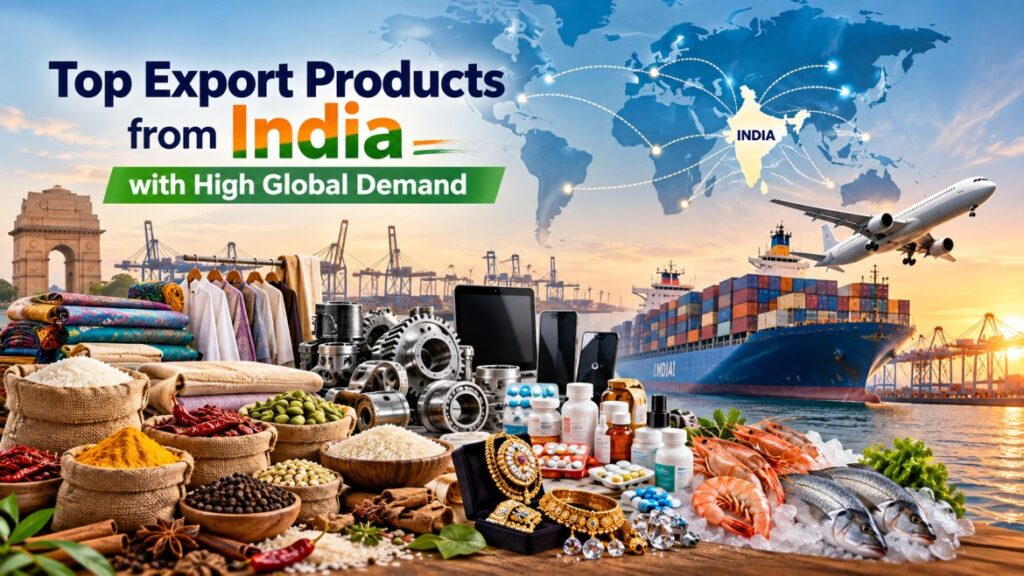
Top export products from India are attracting international buyers seeking reliable manufacturing, competitive sourcing options, and diverse product categories. From engineering goods and pharmaceuticals to textiles, rice, spices, electronics, and seafood, India plays an important role in global merchandise trade.
According to the Ministry of Commerce and Industry, India’s merchandise exports reached approximately US$441.8 billion in FY 2025–26, reflecting the country’s extensive manufacturing and export capabilities.
For foreign importers, distributors, wholesalers, and businesses exploring international sourcing, identifying the right products is only the beginning. Product quality, reliable manufacturers, export documentation, pricing, and destination-country regulations are equally important.
This guide explores the top export products from India, major opportunities for international buyers, essential export requirements, and practical steps for building successful sourcing partnerships.
Businesses looking for Indian manufacturing partners can explore Savi Enterprises Supplier and Manufacturer Sourcing Services.
Why India Is an Important Global Export Market
India has developed an extensive manufacturing and sourcing ecosystem covering traditional products and technology-driven industries.
Several factors support India’s export competitiveness:
- Established manufacturing clusters across multiple states
- A diversified range of agricultural and industrial products
- Skilled workers and specialized production capabilities
- Export-oriented manufacturers and suppliers
- International trade agreements and market access opportunities
- Government-supported export promotion initiatives
- Growing capabilities in electronics and engineering manufacturing
India’s strength lies in the variety of industries available to buyers. An international company can source textiles, machinery components, spices, packaging materials, pharmaceuticals, and many other products from different manufacturing regions.
However, buyers should evaluate suppliers individually rather than assuming that every Indian manufacturer offers identical quality or export capabilities.
For businesses requiring supplier identification and product research, Savi Enterprises provides sourcing and business coordination support.
India’s Major Export Categories: Latest Available Annual Data
The following figures show selected leading merchandise export categories for FY 2025–26.
| Export Category | Export Value (Approx.) |
|---|---|
| Engineering Goods | US$122.4 billion |
| Petroleum Products | US$53.8 billion |
| Electronic Goods | US$48.0 billion |
| Drugs and Pharmaceuticals | US$31.1 billion |
| Organic and Inorganic Chemicals | US$28.7 billion |
| Gems and Jewellery | US$28.2 billion |
| Ready-Made Garments | US$15.8 billion |
| Rice | US$11.5 billion |
Source: Department of Commerce – Merchandise Export Statistics
These values represent broad export categories rather than individual products. High export value does not automatically mean high profit margins or easy entry for new exporters.
1. Engineering Goods and Machinery
Engineering goods are among the top export products from India, supported by manufacturers producing industrial machinery, automotive components, mechanical equipment, and electrical engineering products.
Popular Engineering top export products from India
- Automobile parts and accessories
- Industrial pumps and motors
- Valves and mechanical components
- Electrical machinery
- Metal fabrication products
- Agricultural machinery
- Industrial tools and equipment
Engineering products serve industries such as manufacturing, infrastructure, construction, agriculture, transportation, and industrial maintenance.
Why International Buyers Source Engineering Goods from India
Indian manufacturers offer a wide selection of standardized and customized industrial products. Some suppliers also support OEM manufacturing, contract production, and private-label requirements.
Before purchasing, buyers should verify technical drawings, material specifications, testing certificates, manufacturing capacity, and warranty responsibilities.
For professional assistance, explore Supplier and Manufacturer Verification in India.
2. Electronic Goods and Electrical Equipment
Electronic goods are another important category among the top export products from India.
India’s electronic goods exports reached approximately US$48 billion during FY 2025–26, indicating the increasing importance of electronics in the country’s manufacturing export basket.
Common Electronic Export Products
- Smartphones and mobile devices
- Electronic components
- Electrical assemblies
- Consumer electronics
- Power supply equipment
- Communication equipment
- Electronic accessories
International buyers may find opportunities in contract manufacturing, component sourcing, and selected finished products.
However, electrical products can require destination-specific safety testing, technical certification, electromagnetic compatibility compliance, and labeling.
Exporters should confirm applicable standards before accepting large international orders.
3. Pharmaceuticals and Healthcare Products
India has an established pharmaceutical manufacturing industry serving international healthcare markets.
Pharmaceuticals remain among the high-demand export products because healthcare systems require consistent supplies of medicines and related products.
Major Product Categories
- Generic medicines
- Pharmaceutical formulations
- Active pharmaceutical ingredients
- Pharmaceutical intermediates
- Selected healthcare consumables
According to Department of Commerce statistics, pharmaceutical exports were approximately US$31.1 billion during FY 2025–26.
Important Considerations
Pharmaceutical exports are highly regulated. Manufacturers and buyers should verify:
- Manufacturing licenses
- Good Manufacturing Practice compliance
- Product registration in the destination country
- Quality testing documentation
- Shelf-life requirements
- Importer authorization and applicable approvals
Businesses can review Indian regulatory information through the Central Drugs Standard Control Organisation.
Pharmaceutical exporting should be approached as a regulated business rather than a simple trading opportunity.
4. Petroleum and Refined Products
Petroleum products represent one of India’s largest merchandise export categories.
Refined fuels and related products are supplied through established energy-sector companies and international trading arrangements.
While petroleum products contribute significantly to India’s export value, they are generally unsuitable for beginners because operations may require substantial capital, specialized storage, commodity trading expertise, and extensive regulatory compliance.
For new export businesses, smaller and more manageable manufacturing categories may offer a more practical starting point.
5. Gems and Jewellery
India has a longstanding jewellery manufacturing and gemstone processing industry.
Gems and jewellery remain important Indian export products for international retailers, wholesalers, jewellery brands, and specialized distributors.
Popular Export Products
- Cut and polished diamonds
- Gold jewellery
- Silver jewellery
- Gemstone jewellery
- Custom jewellery
- Designer jewellery collections
India’s gems and jewellery exports were approximately US$28.2 billion in FY 2025–26.
Before sourcing, international buyers should verify precious-metal purity, gemstone grading, product authenticity, valuation, supplier credentials, and relevant customs requirements.
The Gem & Jewellery Export Promotion Council provides industry information and export-related resources.
6. Textiles, Garments and Home Furnishings
Textiles are among the most accessible top export products from India for businesses exploring wholesale sourcing and private-label manufacturing.
Indian textile manufacturers produce products for fashion brands, retailers, hotels, distributors, and home furnishing businesses.
Products Commonly Exported
- Cotton garments
- T-shirts and shirts
- Women’s clothing
- Home textiles
- Bedsheets and pillow covers
- Towels and bath linen
- Fabrics and textile accessories
Why Buyers Consider Indian Textile Manufacturers
Many suppliers offer fabric selection, stitching, embroidery, printing, packaging, and private-label production.
Businesses should confirm minimum order quantities, fabric composition, colorfastness, shrinkage, stitching quality, and delivery schedules.
For brands seeking contract manufacturing, supplier verification and approved production samples are particularly important.
Learn how Savi Enterprises assists international buyers through its Indian Supplier and Manufacturer Sourcing Services.
7. Rice and Agricultural Commodities
Agricultural commodities are significant products exported from India, particularly rice.
India supplies several varieties of rice to international food distributors, wholesalers, supermarket chains, and food-service businesses.
Major Rice Categories
- Basmati rice
- Non-basmati rice
- Specialty rice varieties
According to APEDA’s Basmati Rice data, India exported approximately US$5.67 billion of basmati rice in FY 2025–26.
Major destinations included Saudi Arabia, Iran, Iraq, the United Arab Emirates, Yemen, and the United States.
Non-basmati rice also represents a major export category, with demand across multiple regions.
Important Export Checks
- Grain variety and specifications
- Moisture content
- Broken-grain percentage
- Packaging quality
- Destination-country food standards
- Phytosanitary requirements, where applicable
- Current DGFT export policy and any applicable restrictions
Food exporters should check product-specific rules before accepting orders.
8. Indian Spices and Seasonings
Spices are among the most recognizable Indian export products globally.
India exports whole spices, powdered spices, spice mixtures, extracts, and value-added seasoning products.
Popular Export Spices
- Red chilli
- Cumin
- Turmeric
- Black pepper
- Cardamom
- Coriander
- Ginger
- Spice oils and oleoresins
According to the Spices Board of India, India exported approximately US$4.43 billion worth of spices and spice products in FY 2025–26.
The United States, China, UAE, Bangladesh, and Saudi Arabia were among the major export destinations.
Business Opportunities
Spice manufacturers may offer bulk sourcing, private labeling, retail packaging, and customized spice blends.
Before importing, buyers should verify pesticide residue limits, microbiological standards, traceability, packaging specifications, and destination-country food safety rules.
9. Seafood and Marine Products
Seafood is another important category among the top export products from India.
Frozen shrimp, fish, squid, and other processed marine products serve international food distributors, retailers, restaurants, and institutional buyers.
According to the Marine Products Export Development Authority, India exported approximately US$7.45 billion worth of seafood during FY 2024–25, with frozen shrimp contributing a major share.
Key Considerations
Marine product exporting requires careful attention to:
- Processing facility approvals
- Cold-chain transportation
- Food safety certification
- Temperature-controlled storage
- Product traceability
- Importing-country seafood standards
New businesses should work with qualified processors and experienced logistics providers before entering this sector.
10. Processed Foods and Packaged Products
Processed foods represent another opportunity for businesses interested in export business opportunities in India.
International buyers source Indian packaged foods for ethnic grocery stores, supermarkets, online marketplaces, and food-service businesses.
Potential Export Products
- Packaged snacks
- Biscuits and bakery products
- Pickles and chutneys
- Ready-to-eat meals
- Sauces and seasonings
- Millet-based foods
- Processed vegetables and fruits
Unlike some bulk commodities, packaged foods may allow businesses to build their own brands and differentiate through product development.
However, international success depends on food safety, shelf life, labeling, consumer preferences, and market-specific requirements.
For regulatory guidance, consult APEDA and the FSSAI.
Which Export Products Are Suitable for New Businesses?
The best products to export from India in 2026 depend on business capital, supplier availability, target markets, and regulatory complexity.
| Product Category | Business Opportunity | Important Consideration |
|---|---|---|
| Spices | Bulk supply and private labeling | Food safety and testing |
| Textiles | Wholesale and customized manufacturing | Quality and MOQ |
| Home Furnishings | Retail and hospitality sourcing | Material and finishing |
| Packaged Foods | Branding and distribution | Shelf life and food regulations |
| Engineering Components | Industrial B2B supply | Technical specifications |
| Jewellery | Retail and custom design | Authentication and valuation |
| Electronics | Components and finished products | Certification and technical compliance |
Important: These are potential business opportunities, not guaranteed profitable export categories. Profitability depends on sourcing cost, freight, duties, distribution costs, exchange rates, and customer demand.
How to Find the Right International Market for Your Product
Choosing the right product is only one part of an export strategy.
Businesses should research the countries that already import similar goods, identify suitable customer segments, study tariffs, and compare competitor pricing.
Useful research questions include:
- Which countries import the product regularly?
- What are the product’s applicable HS codes?
- Are there any import restrictions or additional taxes?
- What certifications does the buyer’s country require?
- Can Indian manufacturers supply the required quantity and quality?
- What is the final landed cost after freight, duties, and insurance?
The Government of India’s Trade Intelligence and Analytics Portal offers information about commodity-level export trends, international destinations, and trade performance.
Savi Enterprises also offers Indian Market Analysis and Research to support product research, supplier identification, competitor evaluation, and business planning.
Essential Documents for Exporting Products from India
Companies planning international shipments should review the documents required for their specific products and destinations.
| Document | Purpose |
|---|---|
| Importer Exporter Code (IEC) | Exporter identification under DGFT requirements, unless exempt |
| Commercial Invoice | Details of the transaction and product value |
| Packing List | Shipment quantity, packaging and weight details |
| Shipping Bill | Indian customs export declaration |
| Bill of Lading / Airway Bill | Transport documentation |
| Certificate of Origin | Establishes product origin when required |
| Product Test Certificates | Demonstrates conformity where applicable |
| Phytosanitary / Health Certificate | For applicable agricultural or food products |
| Insurance Certificate | Where required under the agreed shipment terms |
The exact paperwork depends on the product, destination, shipping method, and applicable trade rules.
For official guidance, visit the Directorate General of Foreign Trade and the ICEGATE Customs Portal.
Complete Checklist Before Selecting Indian Export Suppliers
International buyers should not finalize suppliers based only on online quotations.
Supplier Verification
- Verify company registration and GST details
- Check IEC and relevant licenses
- Confirm whether the supplier is a manufacturer or trader
- Review production capacity
- Request company profiles and business references
Product Verification
- Collect product samples
- Approve detailed specifications
- Review test certificates
- Verify packaging and labels
- Confirm quality inspection arrangements
Commercial Verification
- Request a detailed written quotation
- Confirm minimum order quantity
- Finalize payment terms
- Agree on Incoterms and shipping responsibility
- Establish clear timelines
- Define procedures for rejected or defective goods
For larger orders, factory inspections or third-party quality checks may reduce procurement risks.
Learn more about Savi Enterprises Supplier and Manufacturer Verification Services.
Common Mistakes to Avoid in Export Business
Businesses exploring top export products from India should avoid these common mistakes:
- Selecting products without researching overseas demand
- Choosing suppliers only because they offer low prices
- Ignoring destination-country regulations
- Placing bulk orders without sample approval
- Underestimating shipping and customs charges
- Using incorrect HS classifications
- Agreeing to unclear payment terms
- Neglecting product testing or export documentation
- Relying entirely on one supplier
- Failing to verify overseas buyers and distributors
A structured export sourcing strategy helps businesses reduce avoidable risks and build more stable commercial relationships.
How Savi Enterprises Helps with Export Product Sourcing in India
Finding the right export products from India requires more than identifying popular categories.
Businesses need dependable Indian manufacturers, appropriate quality standards, commercially suitable pricing, and reliable coordination.
Savi Enterprises provides professional business support for domestic and international companies seeking Indian sourcing and market opportunities.
Services include:
- Supplier and Manufacturer Search: Identifying manufacturers, suppliers, exporters, and wholesalers for specific product requirements.
- Supplier Verification: Coordinating company background checks, factory visits, product samples, and quality assessments.
- Market Research: Evaluating products, competitors, market conditions, and commercial opportunities.
- Buyer Matchmaking: Connecting businesses with Indian buyers, importers, distributors, dealers, and strategic partners.
- Certification Support: Assistance with applicable licensing, documentation, and regulatory requirements.
- Business Coordination: Supporting communication, negotiation, documentation, and shipment follow-up.
Explore Savi Enterprises’ Supplier and Manufacturer Services, Buyer Matchmaking Services, and Business Certification Services.
Frequently Asked Questions
1. What are the top export products from India?
Major export categories include engineering goods, petroleum products, electronics, pharmaceuticals, chemicals, gems and jewellery, textiles, rice, spices, and seafood. Export values and demand differ across countries and years.
2. Which Indian products have strong international demand?
Engineering components, electronic goods, pharmaceutical products, rice, spices, textiles, jewellery, and marine products have established international export markets. Businesses should research the specific destination country before selecting a product.
3. How can I find Indian manufacturers for export?
Start by identifying the required product specifications, researching potential suppliers, verifying business registrations, checking production capabilities, requesting samples, and conducting factory inspections when appropriate.
Savi Enterprises offers Supplier and Manufacturer Sourcing Support for businesses seeking verified Indian sourcing options.
4. Is IEC required for exporting from India?
An Importer Exporter Code is generally required for merchandise exports, subject to applicable exemptions. Businesses can check eligibility and apply through the official DGFT portal.
5. Which products are suitable for a small export business?
Spices, home textiles, garments, handicrafts, and selected packaged products may be worth evaluating because buyers can sometimes begin with relatively small orders. However, sourcing costs, regulatory requirements, and profit margins must be assessed individually.
6. Can Savi Enterprises help overseas companies source Indian products?
Yes. Savi Enterprises assists businesses with manufacturer searches, supplier verification, product samples, market research, business coordination, and sourcing support in India.
Conclusion
The top export products from India demonstrate the country’s diverse manufacturing capabilities and international trade opportunities. From engineering and electronics to agricultural products, textiles, spices, and seafood, India offers sourcing possibilities for many business sectors.
However, successful international trade depends on choosing the right products, verifying manufacturers, understanding market demand, checking regulatory requirements, and managing commercial risks.
For international buyers and companies planning to source products from India, reliable local support can simplify supplier selection and business coordination.
Looking to source high-demand Indian products for your business?
Connect with Savi Enterprises for Indian manufacturer sourcing, supplier verification, market research, business matchmaking, and import-export coordination support.
Website: www.savienterprises.in
Data note: Annual trade values refer to the stated financial years. Product-specific export policies, international demand, shipping conditions, and certification requirements should be rechecked before entering into commercial agreements.